
What to Expect at Your Child's First Eye Exam | Richmond
September 16, 2026
What to Expect at Your Child's First Eye Exam
Your child relies on their eyes for almost everything they do in a day, from reading the board at school to finding your face across a busy playground. Most kids won't say a word when things look blurry. They assume everyone sees the world the way they do.
That's part of why an early eye exam matters. A first eye exam checks how clearly your child sees and how well their eyes work together, and it can happen long before they know a single letter of the alphabet.
When to Book Your Child's First Eye Exam
Most kids can have their first exam at 6 months old. Your baby can't read a chart yet, but we can learn a lot from how their eyes move and respond to light.
Book the next one somewhere around age 3, once your child can name shapes and colours. After that, yearly visits help keep their sight on track through every new grade.
In Ontario, OHIP covers one annual eye exam for children under 20, so cost doesn't have to weigh into the decision.
Vision concerns also tend to run in families. Tell us if glasses, lazy eye, or crossed eyes show up on either side of the family tree, since your child may need to come in more often than the usual schedule suggests.
What Happens During the Exam
A first eye exam usually takes 20 to 30 minutes and feels closer to a set of games than a medical appointment. What we do depends a lot on your child's age.
Babies and Toddlers
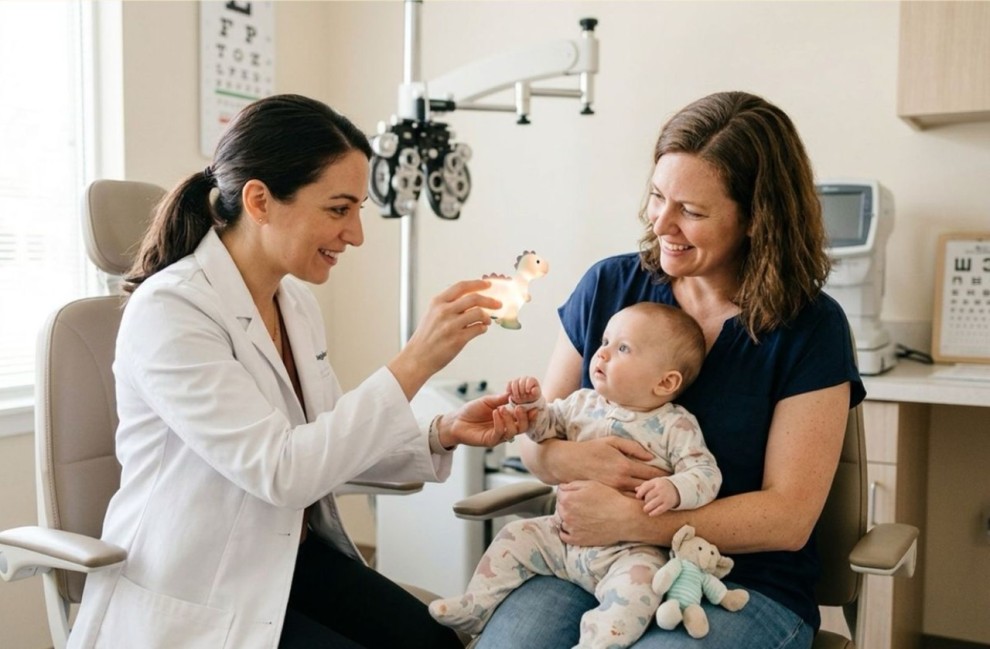
With babies and toddlers, we watch how they lock onto a small toy and follow it as it moves. A light shows how their pupils react, and striped cards show which patterns they prefer, which hints at how much detail they can pick out. Prepare to answer a few questions about their birth history and development.
Preschool and School-Age Kids
Older kids match pictures or read letters on a chart. We check depth perception and how well the two eyes work together, then assess colour vision and the health of the eye itself.
If glasses could help, we can measure the prescription with a handheld light and a set of lenses. Your child doesn't have to say a thing for that part. Let them know ahead of time that guessing is fine and nothing in the exam should hurt.
EyeTech Optometry also participates in the Eye See Eye Learn® program, which supports children in Junior and Senior Kindergarten. Eligible children can receive a comprehensive eye exam covered by OHIP and, if glasses are prescribed, a complimentary pair of glasses through the program.
.jpg)
Signs Your Child May Have Vision Problems
Kids rarely complain about blurry vision, so their habits at home are often the first hint. Watch for a few of these:
- Squinting or tilting their head to see something
- Rubbing their eyes often, even when they aren't tired
- Sitting very close to the TV or holding a book near their face
- Headaches that show up after school
- Losing their place or skipping lines while reading
One sign on its own may not mean much. A repeating pattern is worth mentioning at the next visit.
Eye Conditions Optometrists Look For in Children
A handful of conditions come up often in childhood, and most respond better the earlier they're found:
- Nearsightedness, which blurs anything at a distance
- Farsightedness, which makes close work like reading harder to keep up
- Astigmatism, which can blur vision at any distance
- Lazy eye, where one eye doesn't develop the sharpness it should
- Crossed or misaligned eyes, which can affect depth perception
Managing Myopia as Your Child Grows
For children with progressing myopia, care can involve more than updating a pair of single-vision glasses when the prescription changes. Myopia management focuses on both helping your child see clearly and monitoring how their eyes are changing as they grow.
At EyeTech Optometry, we have invested in the MYAH diagnostic tool, which allows our optometrists to measure the length of the eye and track changes over time. These measurements give us another way to monitor myopia progression and evaluate how a child's management plan is working.
When appropriate, we may also recommend advanced myopia-management lenses such as MiYOSMART iQ, which are specifically designed to help manage myopia progression in children.
Unlike a one-time glasses purchase, myopia management involves ongoing follow-up. Your optometrist monitors changes in your child's prescription and eye growth, checks that their lenses are properly fitted and centred, and adjusts the management plan when needed. The goal is to support clear vision today while carefully following how your child's eyes develop over time.
How to Prepare Your Child for the Visit
A little planning goes a long way. Pick a time of day when your child is rested and you aren't rushing in from somewhere else. A calm morning tends to go better than a squeezed-in afternoon.
Bring a favourite toy or blanket so the room feels friendlier. Talk about the appointment beforehand in simple words, something like: the optometrist wants to look at your eyes and play a few games with pictures.
Most children's eye exams are straightforward and designed to feel comfortable and engaging. If the optometrist recommends any additional testing during the visit, they can explain what it involves and help you and your child know what to expect.
Book Your Child's First Eye Exam Today
Your child's sight shapes how they learn, play, and see the world around them. A first exam is a small step that can make a big difference for the whole family.
The team at Eyetech Optometry is here to make the visit easy and welcoming, with OHIP coverage for kids and direct billing to take the guesswork out of the paperwork. Contact us today to book a spot for your little one and start them off on the right foot.
We're here to help,
Dr. Robert A. Lima