
The Basics of Your Eye Exam: Astigmatism, Nearsighted vs. Farsighted, Explained
September 30, 2026
The Basics of Your Eye Exam: Astigmatism, Nearsighted vs. Farsighted, Explained
A few terms tend to come up after a routine eye exam, and nearsighted, farsighted, and astigmatism are some of the most common. Each one describes how your eye focuses light, and nearsightedness makes faraway things look blurry and farsightedness makes close-up tasks harder, while astigmatism comes from an uneven curve in the eye that can make things look blurry at any distance.
We talk through these results with patients every day.
How Your Eyes Focus Light
Light enters through the clear front of your eye, called the cornea, and then passes through the lens behind it. Together, they bend the light so it lands on the retina at the back of your eye. The retina turns that light into signals, and your brain reads those signals as a picture.
When light lands in front of or behind the retina, things look blurry. Optometrists call these focusing problems refractive errors, and glasses or contact lenses can correct them by changing how light enters your eye.
Nearsighted vs. Farsighted: What's the Difference?
Both conditions usually come down to the length of your eye or the curve of your cornea. Here's how each one can affect your vision.
What Nearsightedness Means
With nearsightedness, also called myopia, faraway things look blurry while close-up things stay sharp. It happens when your eyeball is a little too long or your cornea curves too much, so light focuses in front of the retina.
Nearsightedness often starts in childhood. Kids with nearsighted parents are more likely to develop it, and their prescription may go up as their eyes grow.
Send your kids outside to play every day, since researchers have linked more time on screens and close-up work to a higher risk of myopia. And watch for a few of these signs:
- Squinting at road signs or the TV
- Sitting close to the television
- Headaches after hours on a screen
What Farsightedness Means
Farsightedness, or hyperopia, makes close-up tasks like reading a menu or threading a needle harder. Your eyeball may be a bit too short or your cornea too flat, so light focuses behind the retina.
Your eyes have to work harder to bring things into focus. After long stretches of reading, that extra effort can leave them tired and achy, and some people get headaches too.
School vision screenings often miss farsightedness because kids can still read the letters on a chart across the room. Mild cases may only need glasses for reading or computer work.
What Is Astigmatism?
Astigmatism happens when your cornea or lens has an uneven curve. Picture a typical cornea as round like a basketball. With astigmatism, the curve looks more like a football, which sends light to 2 focus points instead of 1.
Most people have a small amount of astigmatism, and it often shows up alongside nearsightedness or farsightedness. Small amounts may not need correction. Larger amounts can cause symptoms like these:
- Blurry or stretched vision at every distance
- Squinting to see details
- Eye strain
- Headaches by the end of the day
- Glare or halos around headlights at night
.jpg)
How to Read Your Eye Prescription
OD stands for your right eye and OS stands for your left eye, and it's normal for the numbers for each eye to look quite different.
Here's what the other columns mean:
- SPH (sphere): How much focusing power you need. A minus sign points to nearsightedness, and a plus sign points to farsightedness.
- CYL (cylinder): How much correction you need for astigmatism. If this column is blank, you don't need any.
- Axis: The direction of the uneven curve, written as a number from 1 to 180.
- ADD: Extra power for close-up reading, which many people start to need in their 40s.
Bring your prescription along when you pick out new glasses.
What Happens During an Eye Exam
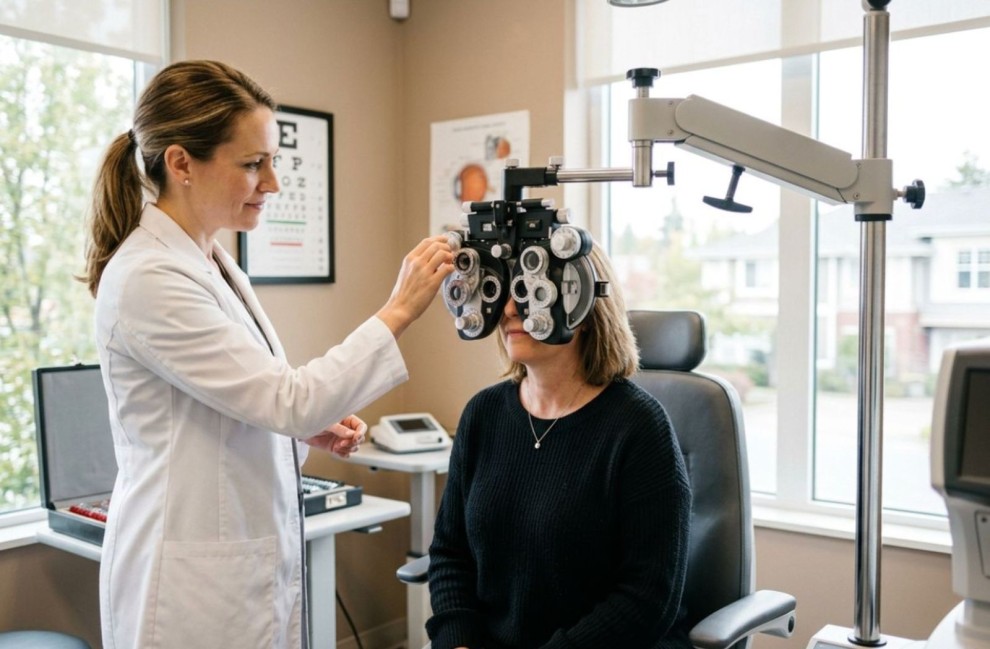
At the start of your exam, your optometrist checks how well you see up close and far away. Then you'll look through a series of lenses and say which ones look clearer, which helps them work out your prescription.
We also examines the health of your eyes, from the front surface to the retina. This part of the exam can help them find early signs of conditions like dry age-related macular degeneration (AMD), which affects your central vision. If they do, ask about MacuMira, a treatment option for dry AMD.
In Ontario, OHIP covers yearly eye exams for kids and teens 19 and under and adults 65 and older. We also direct bill to over 20 insurance companies, so you won't have to deal with as much paperwork.
Clearer Answers About Your Blurry Vision
Call us if any of these sound familiar:
- Blurriness that keeps coming back
- Headaches after reading or screen time
- Your child squints at the board at school
- It's been a while since your last exam
At Eyetech Optometry, we'll walk you through your results and answer your questions about your prescription. Book an appointment and give your family's eyes the care they need.
We're here to help,
Dr. Lima